
The cannon’s screen
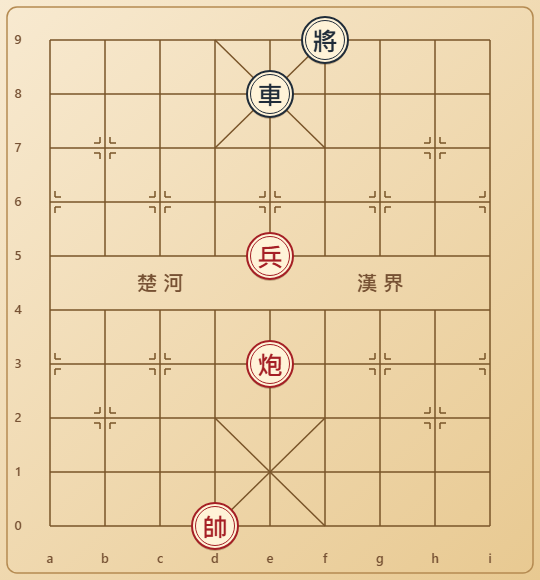
How can you capture the black chariot on e8?
Show solution
e3–e8. The cannon jumps over the red soldier on e5, its only screen, to capture the chariot.
Learn the rules of Chinese chess, try three puzzles, and see how tournament arbiters rule on repetition.
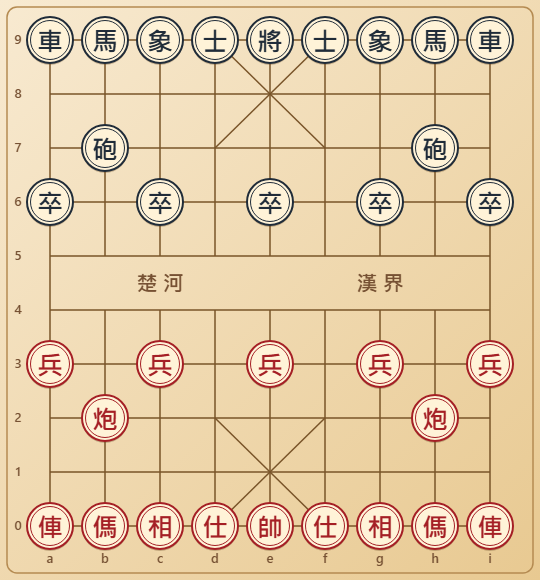
Red moves first in all three positions. Files run from a to i, and ranks from 0 to 9 starting at the bottom.
How can you capture the black chariot on e8?
e3–e8. The cannon jumps over the red soldier on e5, its only screen, to capture the chariot.
Which move is legal, e4–g5 or e4–f6?
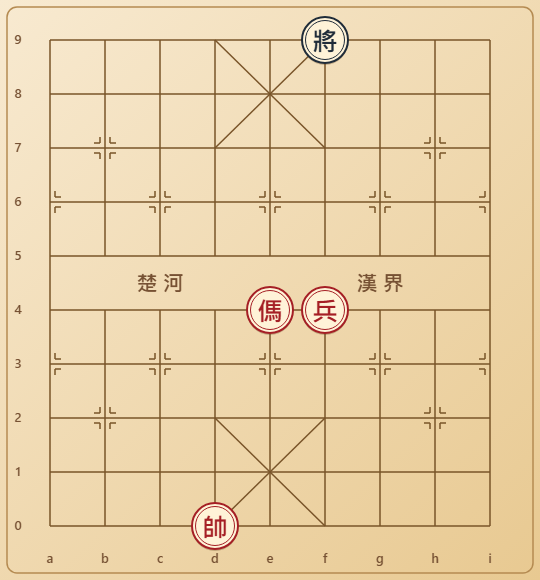
e4–f6. The first step through e5 is clear. The soldier on f4 blocks the first step towards g5.
Which red chariot move gives checkmate?
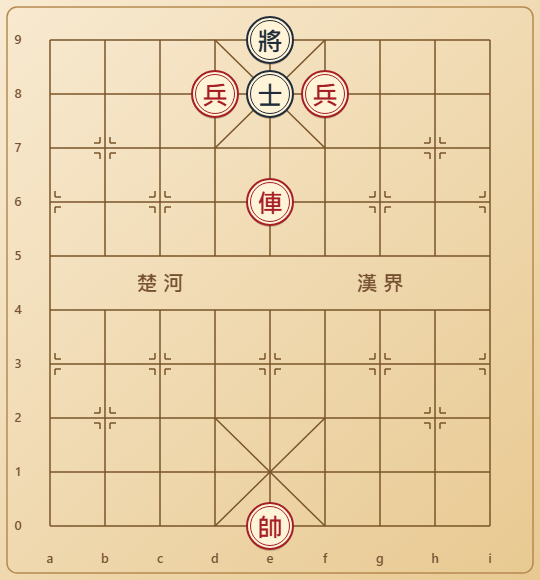
e6–e8. The chariot captures the advisor and gives check. The soldiers cover d9 and f9 and protect the chariot on e8.
Replay the cycle and look at what each side is doing. A check attacks the general directly. A mating threat prepares mate on a later move. A chase threatens to win a piece. Whether a move counts as a chase depends in part on whether the attacker can be recaptured after taking the piece.
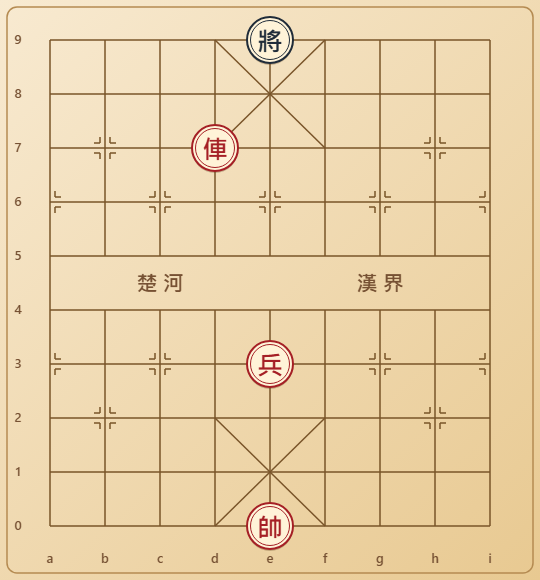
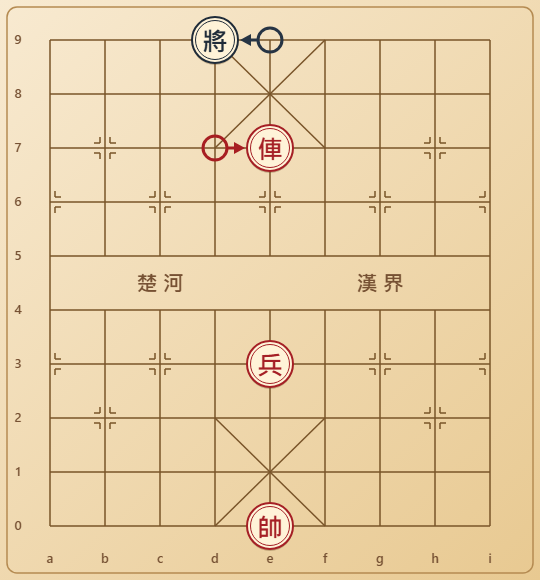
Red continues with 2. e7–d7+ and Black replies d9–e9, returning to the starting position. The chariot gives check on every Red move. All three rulebooks penalise one-sided perpetual check.
A player who perpetually checks loses. If both players give check on every move of the cycle, the game is drawn. Repeated mating threats and alternating check and mating threat are drawn if both sides persist. Chasing a piece protected by a legal recapture is generally permitted. A horse or cannon chasing a chariot is an exception, even if the chariot is defended.
WXF rules, articles 19–21 (English PDF)The published Asian rules call for a draw if neither player varies when one side repeats a mating threat or alternates check and mating threat. If one side gives perpetual check and the other makes a perpetual chase, the checking side must vary or lose. If both players give check on every move, the game is drawn.
AXF adjudication rules and diagrams 4–12 (English PDF)The arbiter normally rules on request after three cycles. At that point, a one-sided perpetual check is an immediate loss. Repeated mating threats and some alternating sequences, including check and mating threat, can require one side to vary. In applicable cases that player generally has two turns to vary the moves.
In a tournament, check the rulebook named by the organiser. Mixed cases are judged on the full sequence of moves.